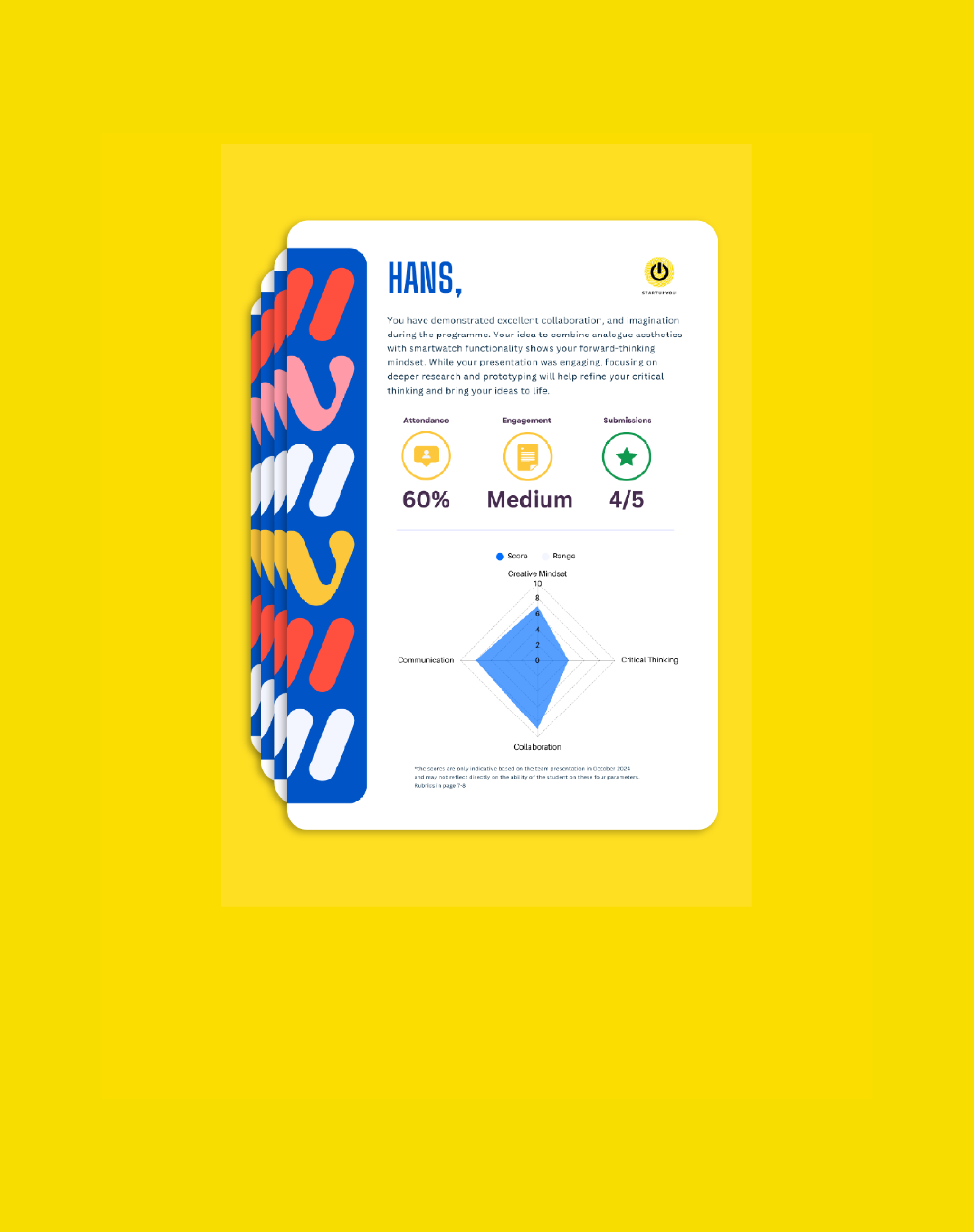
For a learning program tracking creative growth, reports need to be personalised, qualitative and grounded in evidence of practice. Producing 400 reports manually took four faculty members four weeks to compile, condense, design, and publish. The challenge was not only to handle volume, but to do so in a way that gave faculty more bandwidth for meaningful student support.
Faculty captured sharp, evidence-backed notes through structured observations, rubrics, and recorded sessions. An LLM shaped them into warm, consistent narratives, while a custom Sheets–Slides system stitched together inputs, metrics, visuals, and review flows to generate personalised reports in bulk, turning a slow, linear process into a scalable one.
The reporting cycle dropped from 4 weeks to 1 week. Reports were more consistent in tone and richer in qualitative depth than the ones produced manually. Faculty could focus on the quality of observation, without the burden of writing thoughtful paragraphs for hundreds of students. Each report combined a narrative summary, glow and grow sections with specific evidence, and a visual data layer showing individual progress metrics.
The tool exposed weak links upstream. No submissions meant no story to tell; low participation meant thin observations even the best prompt could not rescue. That pushed us to redesign the programme itself. We added a few lower-barrier quests and reworked modules for more active individual participation. In the process, the reporting tool became a way to refine the curriculum itself.